
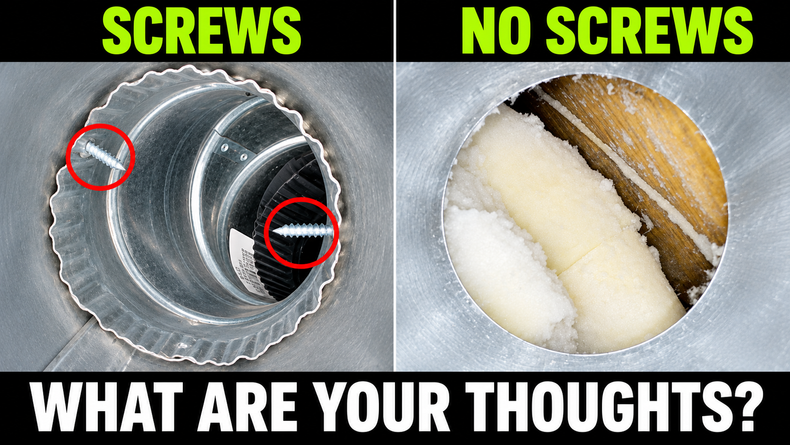
One dryer vent has screws and an intact connection. The other has no screws at the joint, and we find a disconnection. What are your thoughts?
At Vent Vision, we want to talk about what we find in the field and what those findings can teach us. These two separate dryer vent inspections raise a question worth discussing: how do we keep concealed connections secure while minimizing places for lint to collect?
Watch the two inspections
Two separate inspections, shown in one video. Watch on YouTube and join the discussion.
Inspection 1: Screws and an intact connection
In the first inspection, two decent-sized screws hold an elbow to a straight section of vent. They cleaned up completely, did not damage our tools, and honestly, had very little lint on them to begin with.
In this particular inspection, we saw no apparent harm from the screws. That observation alone does not establish that the installation complies with code.
Inspection 2: No screws and a disconnection
What makes the comparison interesting is the second inspection: there are no screws at the joint, and we find a disconnection.
A disconnected vent can go unnoticed inside a wall or ceiling, releasing moisture into the building and potentially contributing to hidden damage and mold.
We cannot say the screws prevented the first vent from disconnecting or that missing screws caused the second one to separate. These are two observations, but they give us a reason to discuss how concealed joints are secured.
What does the code already say?
The 2024 International Residential Code, Section M1502.4.2, already calls for dryer exhaust joints to be sealed and mechanically fastened. It also limits screws and similar fasteners to no more than 1/8 inch of protrusion into the duct interior. That measurement refers to how far the fastener projects inside the duct.
The applicable requirements depend on the adopted code, local amendments, and manufacturer instructions. Some jurisdictions prohibit protruding screws altogether; see, for example, South Carolina's Section 8-1233. A clean joint is not, by itself, proof of compliance.
Should concealed joints have a more specific fastening rule?
Here is the question we want to put to the industry:
What about a rule specifically requiring all concealed dryer vent joints to be mechanically fastened with properly sized screws or rivets?
Because the model code already requires mechanical fastening, this proposal is about specifying the fastening method for concealed joints. Any such rule would need to define acceptable fasteners and protrusion limits.
Would that help prevent hidden disconnections, or are other approved fastening methods the better solution? A good installation should address both concerns: keeping joints connected and minimizing places for lint to collect.
Why the inspection matters
These videos show why it helps to look inside the vent. A camera can reveal visible joint separation, protruding fasteners, and lint buildup, giving the technician and customer something concrete to discuss. It also helps document the areas that were inspected.
Explore our dryer vent inspection cameras to learn more about documenting conditions inside the vent.
What are your thoughts?
How are you securing concealed dryer vent joints? Share your experience in the YouTube comments and tell us what you are seeing in the field.
Would you rather have fasteners that could catch lint or a disconnected vent?